
European Innovation Scoreboard
Using the European Innovation Scoreboard as strategic evidence to strengthen Horizon Europe impact credibility.
When preparing a proposal under Horizon Europe, many applicants focus almost entirely on the work plan, consortium, and technology. However, evaluators also assess credibility of impact and that depends heavily on understanding Europe’s innovation landscape.
Two key EU resources help applicants ground their proposal in evidence:
The European Commission European Innovation Scoreboard (EIS)
The Horizon Europe Programme guidance publication from the Publications Office of the Publications Office of the European Union
Used correctly, they allow you to justify why your project matters, where it should be implemented, and who should be involved.
This article explains what the Scoreboard measures, how it links to Horizon Europe expectations, and how to use it inside a proposal, not as background text, but as strategic evidence.
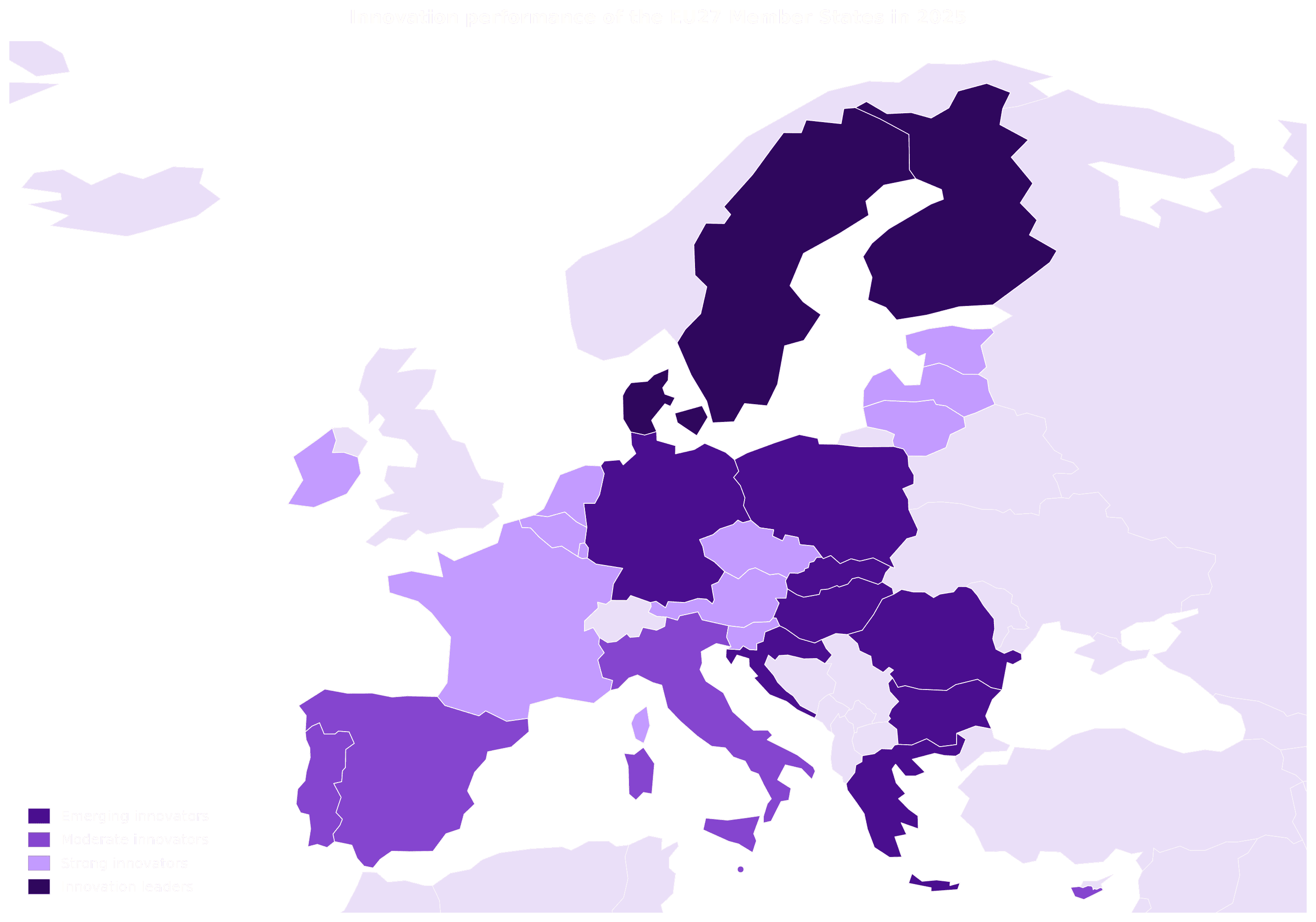
What the European Innovation Scoreboard Measures
The European Innovation Scoreboard is the EU’s comparative benchmarking system for national innovation performance across Member States and associated countries.
Rather than a single ranking, it evaluates innovation capacity across four main dimensions:
1. Framework Conditions
These describe whether a country can innovate.
Indicators include:
Human capital (education, doctoral graduates)
Attractive research systems
Digitalisation readiness
Proposal relevance:
If your project depends on talent development, skills, or training activities, these indicators justify why a region needs capacity-building.
2. Investments
These capture how much a country invests in research and innovation.
Examples:
Public R&D expenditure
Private sector R&D spending
Venture capital availability
Proposal relevance:
This helps demonstrate market failure, a core requirement in Horizon Europe impact sections.
If private investment is low, EU funding becomes clearly additional rather than duplicative.
3. Innovation Activities
This measures whether organisations actually innovate.
Indicators include:
SME innovation rate
Collaboration between companies and academia
Intellectual property activity
Proposal relevance:
Perfect for explaining why your consortium structure is necessary.
For example: low collaboration index → justify strong academia-industry partnership.
4. Impacts
These show economic and societal results of innovation.
Examples:
Employment in knowledge-intensive sectors
Export of high-tech goods
Environmental and digital transition indicators
Proposal relevance:
Directly supports the expected outcomes and pathways to impact section.
Innovation Performance Groups And Why They Matter for Consortia
The Scoreboard classifies countries into four performance categories:
Innovation Leaders
Strong Innovators
Moderate Innovators
Emerging Innovators
This classification is extremely useful when designing a consortium.
Strategic implication
A competitive proposal often combines:
high-capacity countries (technology development)
widening countries (deployment and uptake)
This aligns perfectly with Horizon Europe’s cohesion objective of reducing innovation gaps across Europe.
How Horizon Europe Evaluators Expect You to Use Evidence
The Horizon Europe guidance stresses that impact must be:
credible
measurable
linked to European needs
beyond the state of the art
The Scoreboard provides quantitative proof for all four.
Weak usage (common mistake)
“Country X has limited innovation performance.”
Strong usage (recommended)
“Country X belongs to the Moderate Innovators group and shows below-EU-average SME collaboration rates, justifying pilot implementation and capacity-building activities.”
You are not describing Europe, you are diagnosing a problem your project solves.
Connecting the Scoreboard to Proposal Sections
Excellence Section
Use it to justify scientific gaps:
low patent intensity
weak academia-industry collaboration
limited advanced research systems
Impact Section
Use it to demonstrate European added value:
supports convergence
addresses regional disparities
improves adoption potential
Implementation Section
Use it to structure work packages:
Leaders → technology development
Moderate/Emerging → pilots and validation
All → scaling and replication
Key Takeaway
Think of the European Innovation Scoreboard as:
Not a statistics report but a justification engine.
Use it to:
justify consortium composition
justify pilot locations
justify stakeholder involvement
justify EU funding necessity
Projects fail more often due to weak impact logic than weak technology.The Scoreboard is one of the easiest ways to fix that, yet one of the least used.