
RIA, IA and CSA Projects
Horizon Europe categorizes funding into three main types. Choosing the correct action is vital, as each has distinct requirements for technology maturity (TRL), participant types, and funding rates.
Horizon Europe is structured around different types of actions, each designed to support a specific stage of the research and innovation process. Among the most common are Research and Innovation Actions (RIA), Innovation Actions (IA) and Coordination and Support Actions (CSA).
Understanding how these action types differ is essential when selecting a call, designing a project concept, and building a competitive proposal. Choosing the wrong action type can significantly reduce the chances of success, even when the underlying idea is strong.
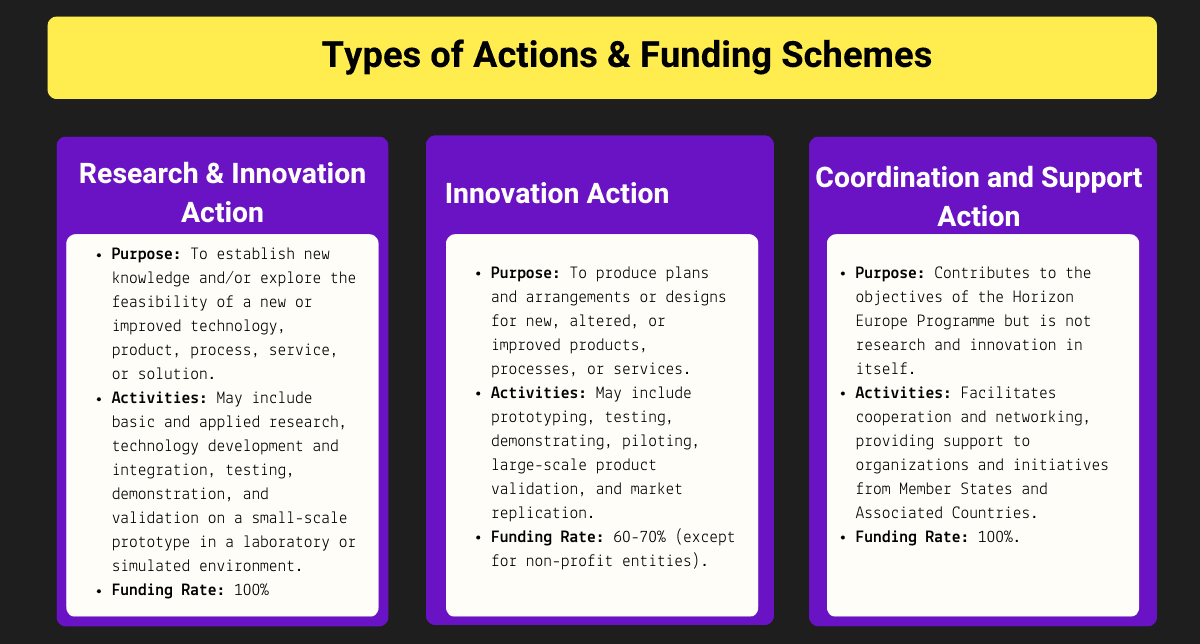
Research and Innovation Actions (RIA)
Research and Innovation Actions (RIA) support projects that focus on creating new knowledge and exploring innovative concepts. They are typically used when technologies, methods, or approaches are still under development and require further research and validation.
Common activities funded under RIAs include:
Basic and applied research
Proof-of-concept and feasibility studies
Development of new methodologies or models
Early-stage validation in laboratory or simulated environments
RIAs usually address lower to mid Technology Readiness Levels, where scientific excellence and technical feasibility are the main priorities. Funding is generally provided at 100% of eligible costs, making this type of action particularly attractive for universities, research organisations, and public bodies. Industry partners may participate, but commercial exploitation is not the primary objective at this stage.
Innovation Actions (IA)
Innovation Actions (IA) are designed to take existing research results and move them closer to real-world application or market uptake. These projects focus less on discovery and more on demonstration, validation, and scaling.
Typical IA activities include:
Development and testing of prototypes
Pilot projects and large-scale demonstrations
Validation in operational or near-market environments
Activities supporting deployment and exploitation
Innovation Actions usually target higher Technology Readiness Levels, where solutions are already proven in principle but require further development to reduce risk and demonstrate impact. Funding rates vary depending on the organisation type, with non-profit entities typically eligible for full funding and for-profit organisations receiving partial funding. Strong involvement from industry, SMEs, and end users is a defining characteristic of successful IA projects.
Coordination and Support Actions (CSA)
Coordination and Support Actions (CSA) differ fundamentally from RIAs and IAs because they do not fund core research or technological development. Instead, they support activities that strengthen research and innovation ecosystems and maximise the impact of funded work.
CSA activities often include:
Networking and stakeholder engagement
Policy support and strategic coordination
Communication, dissemination, and exploitation activities
Training, capacity building, and best-practice exchange
Because CSAs do not focus on developing technologies, Technology Readiness Levels are not applicable. These projects are typically funded at 100% of eligible costs and often involve a wide range of stakeholders rather than technical development partners.
Technology Readiness Levels
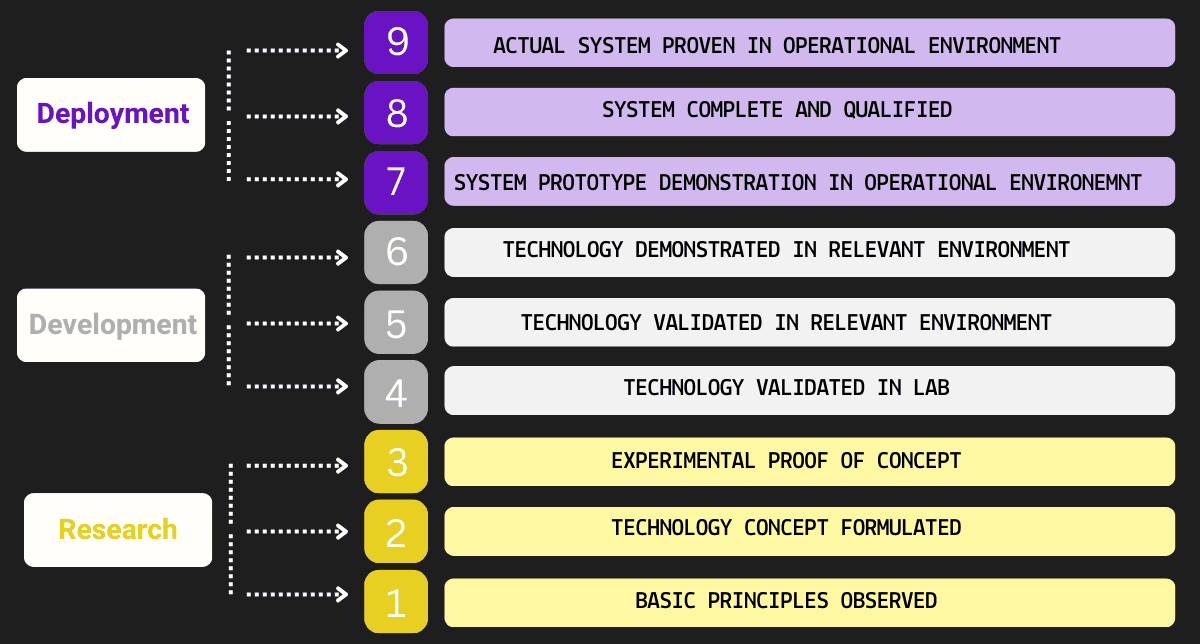
In Horizon Europe, Technology Readiness Levels (TRL) define the scope and maturity of a project's activities, ensuring the right funding for each stage of development.
Research and Innovation Actions (RIA): Focus on basic research and technological development, spanning from TRL 1 to TRL 5. These projects cover everything from observing basic principles to validating technology in a relevant environment.
Innovation Actions (IA): Concentrated on "close-to-market" activities, typically covering TRL 6 to TRL 9. The work involves product demonstration in operational environments and final product manufacturing.
Coordination and Support Actions (CSA): These do not focus on technology development, so the TRL scale does not apply. They prioritize networking, policy support, and dissemination.
How to Choose the Right Action Type
Selecting the correct action type is a strategic decision that shapes every aspect of a Horizon Europe proposal. As a general rule:
RIA is most suitable for research-driven projects at an early or exploratory stage
IA is appropriate for mature innovations ready for demonstration, validation, or deployment
CSA is the right choice for projects focused on coordination, policy, or ecosystem support
Carefully aligning your project idea with the expected action type in the call ensures that evaluators assess it against the right objectives and impact expectations.