
What Is Erasmus+?
Erasmus+: Europe’s Flagship Programme for Learning, Mobility, and International Collaboration
Erasmus+ is the European Union’s flagship programme for education, training, youth, and sport, running from 2021 to 2027. Building on decades of European cooperation in learning mobility, it provides opportunities for millions of people to study, train, volunteer, or gain work experience abroad. The programme is designed to enhance skills, employability, and intercultural understanding, while fostering collaboration between organisations across Europe and beyond.
At its core, Erasmus+ aims to strengthen European cooperation in education and youth initiatives, giving individuals and organisations the chance to innovate, exchange knowledge, and address societal challenges through international learning experiences.
Why It Matters
Erasmus+ goes beyond facilitating mobility and has broad social and economic ambitions. The programme seeks to:
Develop skills and employability by enabling students, trainees, and youth workers to gain practical experience abroad.
Encourage collaboration between universities, schools, training providers, NGOs, and businesses across borders.
Foster social inclusion and active citizenship, giving young people from diverse backgrounds the chance to participate in international projects.
Support innovation in education and youth work, including projects focused on digital skills, sustainability, and community development.
Erasmus+ also contributes to EU policy priorities, including the European Education Area, the Green Deal, and the promotion of digital and social inclusion across member and partner countries.
Priorities
1. Inclusion and Diversity
Aims to ensure equal opportunities, fairness, and accessibility for all participants, especially those with fewer opportunities due to economic, social, cultural, geographic, or other barriers (such as disabilities or educational disadvantages).
Projects should remove participation barriers and actively support under-represented or disadvantaged groups to benefit from Erasmus+ mobility and activities.
2. Digital Transformation
Focuses on enhancing digital readiness, digital skills, and capacity across education, training, youth and adult learning sectors.
Supports purposeful use of digital tools, blended/virtual learning, and resilient digital ecosystems to prepare citizens for a digital age and reduce the digital divide.
3. Environment and the Fight Against Climate Change
Encourages projects to integrate sustainability, environmental awareness, and climate action as central dimensions.
Activities may promote green practices, sustainability education, eco-friendly project implementation, and behavioural change to support the European Green Deal objectives.
4. Participation in Democratic Life, Common Values and Civic Engagement
Seeks to strengthen active citizenship, civic engagement, understanding of democratic processes, and awareness of shared EU values.
Projects should foster critical thinking, intercultural competence, media literacy, and social participation opportunities through both formal and non-formal learning.
How It’s Structured
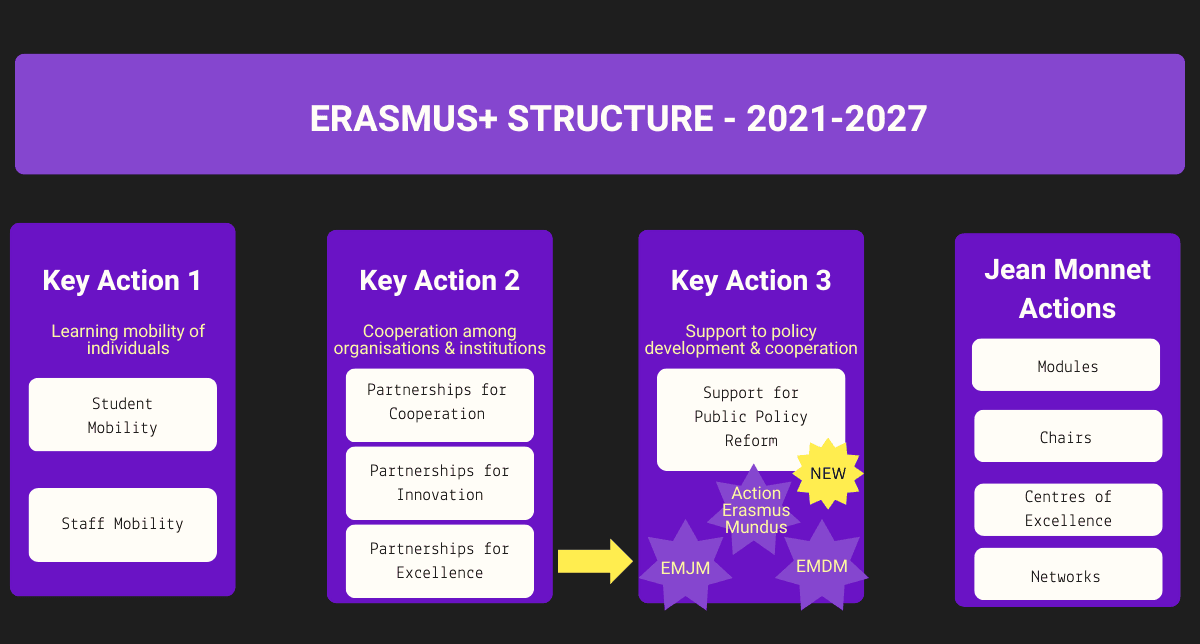
The programme is organised around several key actions, each with a distinct focus:
Key Action 1: Learning Mobility
Supports learners and staff to study, train, and gain professional experience abroad. Promotes active citizenship through youth activities, builds intercultural skills via Virtual Exchanges, and lets 18-year-olds explore Europe with DiscoverEU.
Key Action 2: Cooperation for Innovation and Exchange of Good Practices
Helps organisations improve and connect internationally through partnerships and Alliances for Innovation. Encourages creativity, social entrepreneurship, and cross-sector collaboration. Supports Erasmus Mundus and European Universities, strengthens vocational education through Centres of Vocational Excellence, develops teachers via Erasmus+ Teacher Academies, builds capacity with non-EU partners, and backs not-for-profit European Sport Events.
Key Action 3: Support to Policy Development and Cooperation
Prepares and implements EU policies in education, youth, and sport. Funds policy experiments, supports evidence-based decision-making, improves recognition and transfer of skills, promotes stakeholder dialogue, and strengthens cooperation with international organisations.
Jean Monnet Actions
Supports teaching, research, and debate on the European Union. Offers opportunities across general education, vocational education, and higher education.
Who Can Participate
Erasmus+ is open to a wide range of participants. Individuals including students, trainees, educators, youth workers, and volunteers can access opportunities for learning and mobility abroad. Meanwhile, organisations such as schools, universities, NGOs, and businesses can apply for funding to run collaborative projects or partnerships.
Participation is managed through National Agencies in each country or via EU-level calls administered by the European Education and Culture Executive Agency (EACEA), ensuring a coordinated approach to funding and project support. Erasmus+ is open to EU Member States, associated countries (Iceland, Liechtenstein, Norway, Türkiye, North Macedonia and Serbia), and non-associated third countries that can participate in certain actions. For more information see:
https://erasmus-plus.ec.europa.eu/programme-guide/part-a/eligible-countries
Looking Ahead 2028–2034
Erasmus+ continues to expand its reach and impact, helping participants gain skills, confidence, and international networks that last a lifetime. By fostering cross-border collaboration and innovation in education and youth work, the programme strengthens European cohesion and supports global learning objectives.
The proposed budget for the Erasmus+ programme 2028-2034 is €40.8 billion, significantly higher than the €26.2 billion allocated for the 2021-2027 period, representing roughly a 50 % increase to support wider participation, new activities, and expanded scope across education, training, youth, volunteering and solidarity initiatives.